Clay army of Qin Shihuandi
In the year 210 BC the almighty lord, the first emperor of China, Qin Shihuandi, passed away. During the eleven years of ruling the united China, Qin Shihuandi surrounded himself with a strong army and created a powerful state. He introduced a single monetary system, chronology, writing, as well as a common system of measures and weights. But, a real sensation for archaeologists was the clay army of Qin Shihuandi.
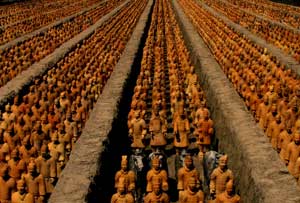
Qin Shihuandi was obsessed with an obsession, a dream of immortality. By his order, the best doctors in China tried to find a recipe for the magic elixir of immortality. And when it became clear that their search was in vain, Emperor Qin ordered to build for himself a grandiose underground mausoleum for the rule of his empire from the other world. And for this, he believed, he would need an army. And he ordered 8 thousand clay idols to be made, believing that the souls of the imperial soldiers would be resettled... So the clay army of Qin Shihuandi began to guard his eternal sleep.
In 1974, for the first time in two thousand years, Chinese archaeologists, led by Professor Yuan Jung-yum, excavated the tomb of Qin Shihuandi. The scientists were immediately struck by the soldiers standing in the fighting order from clay and bronze.
The clay army of Qin Shihuandi was in the same place where it was once set up, inside three underground halls. Most of the foot soldiers are in the main hall with an area of 210x60 square meters. The growth of ordinary infantrymen ranges from 1,75 to 1,85 m. Officers are higher - their growth corresponds to rank and rank.
Warriors and horses of the clay army of Qin Shihuandi are artfully fashioned from clay, and military armor and weapons are cast from bronze. All faces of the soldiers are facing north, towards the tomb of the empress. On the inside of the hollow statues are preserved fingerprints and instruments of the imperial masters. These tracks helped archaeologists recreate the ancient technology of making statues. First, the body was sculpted. The lower part of the statue was monolithic and accordingly more massive - it had a center of gravity. The upper part was hollow. The head and arms were attached to the body after it had been burned in the oven. In conclusion, the sculptor covered his head with an additional layer of clay and sculpted his face, giving it an individual expression. Simultaneously, the warrior "grew" ears, beard. After which, he finally dressed in armor. The roasting lasted several days, at a constant temperature of at least 10000 С. As a result, the clay, from which the warriors were sculpted, became strong as granite.
The first rows of soldiers of the clay army of Qin Shihuandi form three marching ranks, deployed in the direction of eleven underground corridors. Clay warriors stand in the "free" position, but seem ready to rebuild themselves into the battle formation at the first signal. Corridors are also filled with soldiers: in front of the foot follow the chariots of war drawn by four horses. Chariots, unlike clay warriors and horses, were carved out of wood, so almost nothing remained of them.
In the second underground hall, archaeologists counted 1400 earthen clay warriors and horses, different from those that were installed in the first hall. In the forefront here are kneeling archers in armor. And behind them - infantrymen with spears at the ready. There are riders and chariots - both of them occupy strictly defined combat orders.
But even such a powerful clay army, Qin Shihuandi, did not save the Qin Dynasty from destruction, although the state foundations laid by it survived the centuries.
