Gnezdovo
12 km west of Smolensk, on the right bank of the Dnieper, is the village of Gnezdovo. For more than a century now, excavations have been conducted here, shedding light on the most interesting pages of the history of the early medieval Eastern Europe.
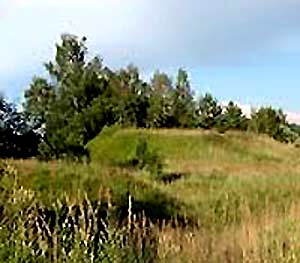
Research Gnezdovo began in the 1880's. Judging by the finds of rough stucco ceramics, people lived here in the early Iron Age - that is, in the middle of the 1st millennium BC. Around 900 AD on a low cape when a stream of lead enters the Dnieper, a settlement springs up surrounded by a rampart and a moat. The area of the site was small - only about 1 hectare. Near the settlement there is a huge burial cemetery 9-10 centuries, consisting of 10 groups. Once here there were up to 4000 mounds, now - about 3000, and yet Gnezdovo is still the largest burial mound in the world. Its area is 37,5 hectares.
What kind of people left these mounds? "The Tale of Bygone Years" calls the inhabitants of these places Krivichi. For a long time no one doubted that the Krivichi was an Eastern Slavic tribe (rather, the tribal union). Archaeological monuments of Krivichi all scientists consider the so-called long barrows. The name "long barrows" was obtained by the characteristic form of the embankment, the length of which is more than twice as wide as its width. People buried in such barrows, the first researchers considered the Slavs. But the well-known archeology scientist A.A. Spitsyn (1858-1931), based on an analysis of the items found in the "long barrows," carried them to the Balts, or rather to the Lithuanians. Today this hypothesis has received a number of new confirmations.
Thus, the indigenous population of the Smolensk Dnieper was the Balts. However, at the last stage of their development Smolensk Krivichi experienced the strongest influence of the Slavs. In the 9-10 centuries in the Upper Dnieper area flowed the Slavic population, who brought here the burial ceremony in round barrows, which replaced the "long barrows" of the eastern Balts.
In the 10th century, Scandinavians-Varangians appeared in Gnezdovo. Judging by the archaeological material, they came here not directly from Scandinavia, but from Lake Ladoga. Varangian burials in Gnezdovo are determined by the Norman features of the funeral rite (burial in boats, the imposition of an iron hryvnia on the urn). However, the Scandinavian graves in Gnezdovo are probably much larger, as many of the burials, especially the male ones, are ethnically indeterminate.
The influx of the population caused an intensive growth of Gnezdovo. On the basis of archaeological material, scientists refer this event to the middle of the 10th century - by the time when the path "from the Varangians to the Greeks" began to be intensively exploited. It was then that the first fortifications appeared in Gnezdovo, at which time the bulk of the local barrows was poured.
Most likely the emergence of Gnezdovo was directly related to the function of controlling the Dnieper trade route - the Varangian squad settled here, was collecting tribute from passing merchant caravans. At the same time, the boats that went along the roads were to be repaired, it was necessary to repair and update the clothes and shoes of travelers, replenish the stockpiles of weapons. This explains the large number of artisans in Gnezdovo. Finds of agricultural implements here are extremely rare.
The intensity of traffic along the trade route that ran through Gnezdovo is evidenced by the finds of thousands of Arabic coins - dirhems, in the 10th-11th centuries. Only seven of treasures with dirhams in Gnezdovo are found, and in one treasure there were 800 dirhams. Along with the Arabian, during the excavations of Gnezdov, Byzantine coins also come across. There are found a huge number of items of both local and foreign origin. These are keys, locks, wooden buckets, knives, files, piercers, hammers, braced for carving fire, combs, buttons, sewing needles, spindle.
The abundance of Scandinavian objects in the nesting burial mounds allowed researchers to assume that it was the Scandinavians-Varangians who were the dominant stratum in Gnezdovo. In any case, the majority of objects of Scandinavian origin, found in the nesting burial mounds, indicate the belonging of the buried to the highest class. In their graves, the richest inventory was found, including expensive Frankish swords (there were seventeen of them in total), common for the early medieval Europe: about 1 m long, a double-edged blade, wide, and often decorated with silver inlaid inlay.
A special place among the finds in Gnezdovo is occupied by numerous ornaments of Scandinavian women. This, above all, gilded bronze fasteners, brooches. In form they resemble an egg shell, so they are called shell-shaped. These brooches, decorated with characteristic Scandinavian ornament, were part of the tribal outfit.
The presence of such a wide range of Scandinavian monuments 9-10 centuries in Gnezdovo shows that in this era the Normans not only penetrated the middle course of the Dnieper, but also settled here. In general, the settlement in Gnezdovo is significantly different from the ancient Russian cities of the 10th-11th centuries. both in terms of planning, and in the forms of social organization.
But another mystery Gnezdovo still seems far from the resolution Recall that only 12 km from this large settlement 9-10 centuries. Smolensk is located, in the era of the early Middle Ages - one of the largest cities of Ancient Rus. But at the same time, no chronicle under any circumstances mentions Gnezdovo, or rather - about the large city that existed on the site of Gnezdovo for a century and a half alongside Smolensk. Why?
The problem of the historical relationship between Gnezdovo and Smolensk different researchers tried to resolve in different ways. A.A. Spitsyn considered Gnezdovo the place of the original Smolensk, from where the city was moved to the present place. Sizov assumed that both cities existed in parallel, while Smolensk played the role of administrative center, and Gnezdovo - trade and handicraft. Maybe Gnezdovo - this is the ancient Smolensk, transferred to the present place in the beginning of the 11th century? Or was there in parallel two competing urban centers in which Smolensk defeated? There is no definitive answer yet. Research continues...
