"Basket makers"
About three and a half thousand years ago, the North American Indians of Cochin began to grow corn. Following this agricultural culture in North America, a culture of "basket makers" - ""basket makers"" arose (approximately 200 BC - 400 AD). It got its name from a special kind of waterproof baskets that had the shape of a pot, which the basket-makers wove to cook food in them.
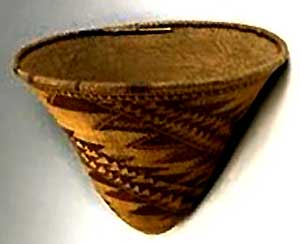
At the same time, to prepare food, they did not bred under a basket of fire, but threw stones burning at the stake. Curiously, the clay pots found in Arizona and New Mexico bear clear indications that, when barely fashioned, they were immediately placed in wicker baskets. This fact gave rise to the hypothesis that "real" earthenware appeared at the very moment when the primitive man first thought of smearing a wicker vessel with clay so that water would not flow out of it. Over time, the wicker base "died out" and was gradually forgotten.
"Basket makers" still lived in caves, but inside these caves they already built real houses. The main habitat of these Indians was Arizona. Here, especially in the dead man's canyon, in various caves numerous traces of the culture of "basket makers" were found.
Dry air conserved a number of objects that the "basket makers" left behind. And according to the surviving remains of the wooden beams of their huts, scientists have roughly determined the time when these caves were inhabited. So, for example, the tree of "basket" buildings near Fall Creek in southern Colorado refers to 242-330. AD A typical settlement of "basket makers" is located in New Mexico, the ancient settlement of Shabilechi - "The place of the image of the sun", named after the petroglyph discovered near the rock.
For two millennia (from the 6th century BC to the 16th century AD), the corrugators occupied a vast territory between The Grand Canyon of Colorado and the headwaters of the Rio Grande. Come here in the 16th century from Canada, the Navajo Indians named the descendants of people of culture "basket makers" in the name of anasazi - "the ancients".
