Mangazeya
In the 16-17 centuries dozens of urban settlements appeared in Siberia. Created as strongholds to move east, they soon became centers of commerce, crafts and crafts. One of these cities was Mangazeya, located beyond the Arctic Circle, in the lower reaches of the Taz River.
The first sea routes to the Mangasee were laid by the Pomors at the turn of the 15th and 16th centuries. In the last quarter of the 16th century, these voyages were particularly frequent. Thanks to them, regular connection of Pomorie with the basin of the Taz River, where Mangazeya originated, was established.
Mangazeya existed for only one century. In 1672 the city was abandoned by the inhabitants. There were many reasons for this. First of all, the general fate of the colonization of Siberia was reflected in the fate of the city. In addition, local fur trades have been scanty, the "sea course" from Pomorze has been stolen.
The short and bright destiny of this mysterious polar city for many years excited researchers.
The first archaeologists who visited the ruins of Mangazeya were V.N. Chernetsov and V.I. Moshinskaya. In the autumn of 1946, they reached the fortress with great difficulty. Scientists confined themselves to compiling a field map and collecting the lifting material, mainly ceramics and fragments of various objects. But finally solve all the mysteries Mangazeya could only systematic excavations. They began in 1968. Excavations Mangazeya led archeological expedition of the Arctic and Antarctic Research Institute under the leadership of M.I. Belova.
Excavations Mangazeya are a unique case in many respects. Archaeologists here did not interfere with any late development, and polar permafrost. But it also contributed to the good preservation of wooden structures and products, items made of leather and fabric.
Archaeologists have uncovered and investigated about 15 thousand square m. of Mangazeya ancient settlement. Remains of ancient defensive structures and about forty buildings of various residential, economic, administrative, commercial and religious purposes were discovered and investigated.
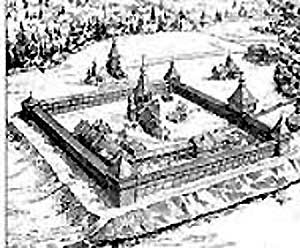
Excavations have shown that Mangazeya had a typical for the ancient Russian cities division into the city proper (kremlin) and posad. Especially intensively, the city grew and was built in 1607-1629. At this time, Mangazeya acquired those special features of the Siberian "untamed" city, which allow it to be placed on a par with such large cities of Siberia in those years as Tobolsk, Tyumen and others. Mangazeya absorbed all the new and the best that Russian architecture knew at the turn of the 16th and 17th centuries. This, above all, affected the implementation of the principles of regular city planning. Mangazeya was well planned: the fortress is clearly separated from the village, and the posad itself is divided into two parts: actually handicraft and trade. Between private buildings appeared paved pine boards of ship's cladding narrow streets and alleys. Particular attention was paid to the development and improvement of the central part of the trading side, which housed a large courtyard surrounded by forty-odd barns and customs with barns. To the west of the courtyard was erected a new religious building - the church of Michael Malein and Makari Zheltovodsky. To the east were located drinking establishments and a city commercial bathhouse. The construction of new houses in the Kremlin has expanded. This, first of all, touched the voivodeship court, behind the massive circular fence of which in addition to the already constructed at the beginning of the century there were two more buildings. The architects connected the new buildings of the voivodeship yard with old huts by hanging closed galleries. The voivodship mansions were also connected to a neighboring hut with a hut.
In 1625 the total length of the walls of the Mangazey Kremlin on the perimeter was about 280 m. There were four deaf towers at the corners: Davydovskaya, Zubtsovskaya, Ratilovskaya and Uspenskaya. On the south side, between Zubtsovskaya and Uspenskaya towers, there was a Spasskaya roadway, reaching a height of 12 m. The smallest was Ratilovskaya tower - 8 m, and the most massive - Davydovskaya, each side of which was about 9 m long. All the towers were quadrangular . The highest wall of the fortress reached between the Davydovskaya and Ratilovskaya towers - about 10 m; The remaining walls had a height of 5-6 m.
One third of the territory of the Kremlin (800 sq. m.) Was occupied by the complex of the voivodeship yard. His excavations gave archaeologists a huge amount of everyday objects of the 17th century - iron arches from buckets, candlesticks, axes, knives with ornamented handles, drills, chisels, chisels, locks of various sizes, burrs, breaks, door bolts, hinges, latch, wooden spoons, plates , bowls, ladles, tubs, rockers, scoops, rolls, cookie shapes, boxes, caskets. Some of these items are artistically decorated.
The main vehicle for communication with the winter huts and moving to farther distances were sledges with reindeer sleds. In the documents of the 17th century it is noted that in the winter time the journey between Mangazeya and Turukhansk took three days. During the excavations of the voivodeship yard, archaeologists found large fragments of the narts themselves, traction from the harness, bone lining for the harness, often with ornamentation.
Domestic character in the Mangazi also bore the foundry. Judging by the finds of a melting spoon and stone molds for casting, local craftsmen cast small items, mainly crosses and women's jewelry.
To the east of the voivodeship yard, in the heart of the fortress, was a catholic cathedral Trinity church, cut down from the cedar. The exact time of its publication is unknown, but from written sources it follows that in 1603 it already existed, or at least was laid. This church burned down in 1642, after which a new one was cut down in the early fifties of the 17th century.
Mangazeya was a large handicraft center, in which almost all the handicraft specialties characteristic of the big city were represented: shoemakers, bone-cutters, casters. In total, in Mangazey Posad, according to estimates of specialists, up to 700-800 people could permanently reside. In addition, at the peak of the season, hundreds of trade and industrial people gathered here. It was for them and it was in the early 17th century (the exact date is unknown) that the Gostiny Dvor building was built. In 1631, during the provincial unrest, it was destroyed.
To date, Mangazeya is still the first and only excavated city, dating back to the era of mastering the vast expanses of Siberia. Archaeological material, obtained as a result of the four-year works of the Mangazey Expedition, became one of the most important sources of study of the Siberian city of the 16th and 17th centuries. On some issues, this source is today the only and sufficiently reliable, which contributes to an accurate dating of almost all the buildings of the city.
