Novgorod
Novgorod - the phenomenon is unique. This city for many centuries was the largest trade center of Eastern Europe, which carried out connections with the cities of Scandinavia and Germany, Prichernomorie and with the Muslim centers of the East. Here arose a special system of political structure, republican in its essence. Novgorod happily escaped the Mongol invasion, and the processes of its development were not deformed by catastrophic destruction.
Large-scale archaeological excavations began in Novgorod at the turn of the 1920s-1930s. In 1951, after a break caused by the war, excavations in Novgorod were resumed. Despite more than half a century of research, so far only slightly more than 1 percent of the territory of ancient Novgorod has been studied.
I must say that from the archaeological point of view Novgorod is unique. Due to the nature of the soil, objects made of organic materials, such as wood, bone, leather, as well as fabrics and grain, are nowhere better preserved anywhere.
The main ornamental material in Russia throughout the Middle Ages was a tree. Wooden pavement appeared in Novgorod in the first half of the 10th century. In the 10th-11th centuries. their width was 2-2,5 m, and later - 3-4 and even 6 m. On a large scale, stone construction in Novgorod began only in the second half of the 18th century.
During excavations of ancient Novgorod archaeologists have tried, first of all, to answer the question: why one of the oldest cities of Russ is called the "new city"? Does it follow from this that Novgorod was preceded by an "old city", and if so, where could it be?
First, archeology has proved that the versions that nominated Old Russ, Staraya Ladoga, etc. as candidates for the "old city" turned out to be groundless. Old Russ - by age even younger than Novgorod, and the Ladoga antiquities have virtually no connection with the Novgorod. As for the "dale-written" Novgorod, there were no layers before the 10th century in the city.
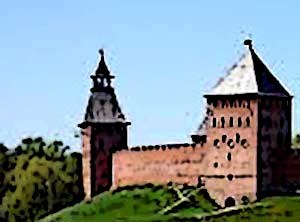
Meanwhile, in written sources, the term "Novgorod" itself, even in the 12th century, as it turned out, was applied not so much to the entire city as to its Kremlin. Apparently, it was this fortress that at first was called the New City. The city itself was formed not from one ancient center, but from three isolated villages from each other, and inhabited by multilingual peoples, called "Slavs, Krivichi and Chud" in Russ chronicles.
The Slavonian end of Novgorod also bore other names - Hill, or Slaven's Hill. Meanwhile, the Scandinavians called Novgorod Holmgard - "Holmgorod". The Nerevsky end retained in its name the name of the Finno-Ugric ("Chud") tribe of the nere, or the people. The main street of Lyudin's end was the Prussian one. Its name, apparently, is connected with the legends about the origin of Novgorod preserved in the chronicle records, in which it is told about the arrival of a part of the Novgorodians from the territory of Prussia.
Thus, the Novgorod Kremlin - the New City - appeared, apparently, as a fortress and an intertribal center of three different nations, having concluded a political union among themselves. At the same time, Novgorod was ruled not by merchants, but by boyar landowners. The ancient princely statehood - veche, posadnik, tysyatsky - was preserved in Novgorod throughout its medieval history, and the role of the invited prince was essentially the role of an arbitrator. Contrary to another common misconception, the prince in Novgorod was not always a military leader - the Novgorodians often invited princesses-babies who could not even mount a horse, not to command the troops.
These and many other details of the life of ancient Novgorod became known to scientists thanks to the famous birch bark letters. The first reading was found on July 26, 1951. Today more than six hundred of these documents are known.
Birch bark letters were found in all stratigraphic strata of Novgorod from the 11th century to the second half of the 15th century. It is characteristic that the oldest record found in Novgorod on birch bark was a Cyrillic alphabet.
Within the Nerevsky end, scientists unearthed several large boyar manors, located along the Great Street. Manors are large in size - the area of each of them reaches 1200-1500 square meters. m. Each such complex consisted of a large two- or three-story manor house, houses for servants, farm buildings and almost always - some craft workshop.
Archaeological excavations made it possible to shed light on the peculiarities of the political structure of Novgorod. It is known that the highest organ of city government was the veche. But what is this? What size then should be the veche area? And where was she?
According to numerous testimonies of ancient acts and chronicles, the city's veche area in the 13th and 15th centuries. was located on Yaroslav Court, near the church of St. Nicholas. The first excavations here were conducted in 1937.
From written sources it is known that at the veche area of Novgorod there was a "degree" - a tribune for posadniki and other leaders of the republic. The square was also equipped with benches - the participants sat for a while, and did not stand. Consequently, the composition of the veche was relatively small - no more than 400-500 people. There was no question of any "national" assembly here. Obviously, each district-end (in ancient Novgorod, as we remember, there were three of them) sent to the veche hundreds of its representatives, and the "best people" - that is, to know. With the extension of the number of ends, first to four, and then to five, the number of participants increased proportionally. Thus, Novgorod was an aristocratic republic.
During the excavations of Novgorod archaeologists discovered about 150 craft workshops 11-15 centuries. In no other medieval city was anything found like this! Among them - workshops of tanners, jewelers, foundry workers, turners, bone carvers, bonders, shoemakers, brewers, weavers, dyers, bread makers, gingerbread men, etc. It was discovered a huge number of tools and the most diverse handicraft products - iron, wood and glass products, fabrics, rings, pads, belt sets, combs, razors, scales, chess pieces.
Novgorod was also of outstanding importance in the system of international trade relations between the West and the East. The main subject of the Novgorod import was raw materials for local handicraft industries - gold, silver, copper, lead, tin. In turn, Novgorod exported fur, walrus, honey, wax, leather, fish.
Excavations of Novgorod continue to this day. Each excavation season brings new discoveries, so it can be safely assumed that Novgorod will present many surprises to science.
