Tiahuanaco
Tiahuanaco is rightly considered the most significant city in the pre-Indian South America. It is located in Bolivia, in the Altiplano mountains, at an altitude of almost 4 thousand meters above sea level and 21 km south of the lake Titicaca. The ruins of Tiahuanaco occupy an area of 4,2 square km.
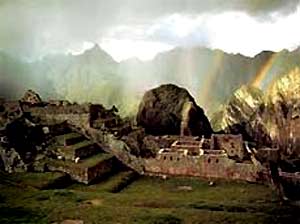
In the Inca language, the name Tiahuanaco means "Dead city". So he was christened already in comparatively late times, when Maita Kapak, the fourth ruler of the Inca empire, visited here. By this time the city had long been emptied. The Incas did not know who built Tiahuanaco. But they were convinced that such majestic structures could be built only by someone exceptional and powerful. In the eyes of the Incas, this was only Kon-Tiki Virakocha - their supreme god.
The cult of Viracocha was widespread among the Indians long before the formation of the Inca empire. The main center of Viracocha worship was Tiahuanaco. It is here, as legends tell us, that Viracocha created the Sun, which, as the Indians thought, became the ancestor of the dynasty of the Inca emperors. It is here, in Tiahuanaco, is one of the most remarkable monuments of Indian culture of all three Americas - the world famous Sun Gate, carved from a huge monolithic lump of andesite weighing many tens of tons. The height of the Sun Gate is about 3 m, and the width is 4 m. The current name of the monument is conditional, and to the reverence of the daylight, he may have had nothing to do.
No residential buildings were found in Tiahuanaco. Although the area occupied by the ruins exceeds 450 thousand square meters. m, the cult center itself consisted of four main buildings located on a small site - 500x1000 m. The first one, Akapan, is a stepped pyramid of 15-meter height. From her to this day there was only a hill with a paved two-hundred-meter platform of the base, to which once the steps were led. At the top there was an extensive pool and several buildings.
Next to Acapana is Kalasasaya - a wide square fenced by a number of stone columns. Here was a building that stood on two rectangular terraces located one on another. German archeologist Arthur Poznansky, the most famous researcher of Tiahuanaco, considered it the ruins of the "main palace". Poznansky believed that Kalasasaya is a building intended for astronomical observations and calculations, a "giant stone calendar".
The most mysterious construction of Tiahuanaco is a semi-underground temple, deepened by 1,7 m into the ground, almost square (28,5x26 m) in terms of the building. Along the entire perimeter of the walls, huge stone pillars are placed at regular intervals, the areas between which are filled with smoothly hewn slabs of smaller size. In the walls of the temple were protruded from the masonry stone heads, and in the center stood statues of deities.
In Tiahuanaco, huge stone monuments (representing a cross between statues and steles), as well as the largest stone statues of pre-Columbian America and named after the scientists who opened them, "Monolith Bennett" and "Monolith Ponce Sanhines", have been preserved.
The Bennett monolith has a height of 7,5 m and is covered with complex relief images. Once this statue was the main idol of a semi-underground temple, explored by the American archaeologist V. Bennett.
The period of blossoming of the Tiahuanaco culture falls on the 3rd-10th centuries AD. At this time, Tiahuanaco was a kind of "South American Athens" - the center of the bright Indian culture, whose influence from the middle of the 1st millennium AD. spread not only to all mountainous Peru, but also to many coastal areas: from the Ecuadorian borders to northern Chile. Everywhere in this territory there are specimens of ornament, originally characteristic only for Tiahuanaco, and motifs taken from the famous Gate of the Sun.
A number of researchers believe that the creators of Tiahuanaco were the ancestors of modern Aymara Indians, the second largest Indian nation of South America, living in the territory of Bolivia and southern Peru. According to another hypothesis, the Tiahuanaco culture is associated with the Uru-Chipaya Indians.
Archaeologists have established that the Tiahuanaco culture disappeared around the 12th century. It is believed that the likely cause of the fall of Tiahuanaco was a colossal earthquake that occurred in the 11th-12th centuries. The waters of Lake Tiahuanaco came out of the shores and flooded the city. At the same time, the lava of the volcanoes raged. Having existed for about a thousand years, the culture of Tiahuanaco died out, giving way to the growing power of the Inca state.
