UNIX operating system
Designed for experienced programmers, the UNIX operating system is characterized by a small number of basic elements that can be combined in an infinite number of ways, and has a sufficient number of means by which programmers can work together and manage the use of common information. Each program should perform only one function, but doing it well is one of the basic rules of the UNIX system.
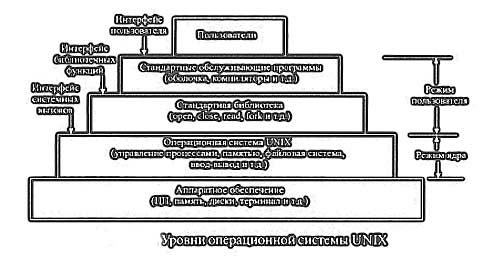
The UNIX operating system can be viewed as a pyramid, at the base of which there is hardware consisting of a central processor, memory, disks, terminals and other devices. The UNIX function is to manage the hardware and provide all programs with system calls. These system calls allow programs to create processes and files and other resources and manage them. In this case, programs access system calls by placing arguments in CPU registers and executing interrupt commands to switch from user mode to kernel mode and transfer control to the UNIX operating system.
All versions of UNIX contain a large number of standard programs, which include the command processor (shell), compilers, editors, word processing programs and utilities for working with files. It is these programs that are launched by the user from the terminal.
In the UNIX operating system, there are three interfaces: the system call interface, the library functions interface and the interface formed by a set of standard maintenance programs. The last, user-oriented interface to the user interface, in some versions of the system was replaced by a graphical, mouse-oriented. It was this flexibility that made the system very popular.
The graphical user interface of the UNIX operating system consists not only of the shell, but also of a large number of standard maintenance programs called utilities. The standardization of these programs is that you can write shells that would work on all UNIX systems. In addition to these utilities, there are many more applications, such as web browsers, image viewers, and so on.
The processes of the UNIX operating system are very similar to sequential classical processes - each can run one program and initially receives one control flow, and several independent processes can work simultaneously. Each user can have several active processes simultaneously, so that hundreds or even thousands of processes can work simultaneously in a large system. The process has one instruction counter that points to the next executable instruction of the processor. UNIX allows the process to create additional threads after it is started.
The UNIX operating system has a file system hierarchical, with files and directories. All disks are mounted in a single directory tree, starting in one root. Individual files can be associated with any tree directory.
