Soap bubble
All, it would seem, told about the soap bubble in his poems S. Ya. Marshak. There is even a hint of a figurative meaning when one says about a person: "It was puffed up like a soap bubble!" But the soap bubble has not only thin glory. English scientist Lord Kelvin, who lived in the last century, once said: "Blow out a bubble and look at it: you can study all your life studying it, without stopping to learn from it physics lessons." And indeed it is. A ball of soap film seems to be multicolored due to interference - reflection light rays from its outer and inner surfaces.
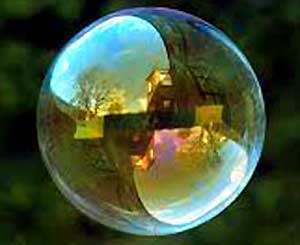
A frozen soap bubble is covered with a very thin film, like an egg shell. And if you throw such a ball on the floor, only the "shell" will break apart, and the shell itself remains unscathed. Well, if you place it above the flame of a spirit lamp, the ball will not burst either, but most likely it will evaporate, decreasing in size. Scientists know, the idea of the fragility of soap bubbles, strictly speaking, does not correspond to the truth. The inventor of the well-known thermos flask, James Dewar, tried to "preserve" soap bubbles in special hermetic containers, and they were stored there for a month or longer. And recently from one American laboratory came the message: one of the soap balls lasted 340 days - almost a year!
The soap bubble film consists of a thin layer of water, enclosed between two layers of molecules, most often soap. These layers contain molecules, one part of which is hydrophilic, and the other is hydrophobic. The hydrophilic part is attracted by a thin layer of water, while the hydrophilic part, on the contrary, is pushed out. As a result, layers are formed that protect water from rapid evaporation, and also reduce surface tension.
The soap bubble does not necessarily have a spherical shape. Soap film, stretched on the skeletons, can take the most incredible shapes. This property is widely used by architects and designers. They know that stretched film will tell them the most economical and stable coating design that can be created with minimal material consumption.
Relatives of the soap bubble - the balloon is used for weather exploration and fascinating air travel. In the mining industry, with the help of bubbles, but air, carry out flotation: the process of enriching the mountain ores. Bubbles in solution envelop the particles of ore and lift it to the surface, and the empty rock remains on the bottom. Studying bursting bubbles, scientists came to an understanding of the processes of cavitation. When this happens in water, the pressure changes very sharply, which can even break down metal, say, the propeller of a ship.
When the two bubbles unite, they take the form with the smallest possible surface area. Their common wall will protrude into the larger bubble, since the smaller soap bubble has greater average curvature and greater internal pressure. If the bubbles are the same size, their common wall will be flat. The rules governing bubbles in conjunction were experimentally established in the 19th century by the Belgian physicist Joseph Plato and mathematically proven in 1976 by Jean Taylor. Now, it turns out, what an amazing, simple bubble it is.
