Osmosis and water molecules
What does it mean to want to drink? This means that the cells of our body do not have enough water. How does a drunk sip of water get into the living cells of our body? Answers to these questions can be obtained by getting acquainted with the phenomenon of osmosis. Nature ordered that if two solutions of different concentrations were separated by a septum that would let the molecules of water pass, but that would trap molecules of the substance dissolved in it, the water molecules would pass into a more concentrated solution, diluting it more and more.
Thanks to osmosis, the first water supply on earth was nature itself. What is osmosis, a patent for which nature received millions of years ago?
Let us explain osmosis by examples. Take the lemon and cut it into thin slices. If the knife is sharp, then there will be almost no juice. After that sprinkle the lemon slices with sugar. After a while, juice will flow from them. Just here osmosis began to act: the juice flowed from the lemon outward, as if trying to dilute the concentrated solution of sugar formed on its surface.
The effect of osmosis can be demonstrated on an ordinary carrot, cutting off its top and instead of cutting it by inserting a tube. If you pour salty water into the tube and place the carrot in a glass with tap water, then after a while you can notice that the water level in the tube will start to creep up. When carrots grow in the garden, the water gets into her tissues in exactly the same way. After all, in its juice, the concentration of salts is higher than in water, which watered the garden...
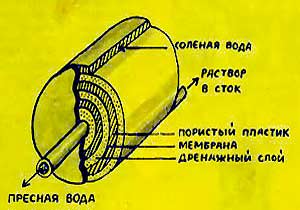
Drunk with the help of osmosis plants, nature gave impetus to the emergence of an interesting method of desalination. In fact, than fresh water differs from salty water? In salt water, in addition to water molecules, there are also salts. If we put a semipermeable membrane between fresh and salt water, the water molecules will strike it more often from the side of fresh water, since there are more of them. Pressure from the side of fresh water will increase, and the water molecules will begin to transfer from fresh water to salt water. Get osmosis. If, on the other hand, pressure is applied to salt water so that it moves to fresh water under pressure exceeding osmotic water, "reverse osmosis" will be obtained, and fresh water will be squeezed out of the salt water through the membranes.
This is what the engineers used to create the desalination plant. The semipermeable membrane is rolled into a roll, where it lies between two layers of porous plastic. In one layer - pressure - under pressure, exceeding osmotic, salt water is supplied. Filtering through the membrane, it enters another layer - the drainage and, already desalinated, flows down to the central discharge tube. Typically, these rolls are installed one after another in the pipe, and the brine from one is repeatedly "squeezed out" in the next.
