Charge of quarks
What is the charge of an electron? The number -1.6*10-19 was first obtained by Robert Millikan, who measured the rate of ascent of contaminated oil droplets in the electrostatic field. The minimum charge that a drop could have had was taken as a single one. In the middle, for example, in the 1960s, the number of elementary particles was measured by hundreds. Murray Gell-Mann and George Zweig theoretically showed that the known properties of many elementary particles can be described by assuming that they are built from several even tiny particles - quarks with an electric charge equal to 2/3 or 1/3 of the electron charge. The very name of the particle quark translates as "trifle", "nonsense".
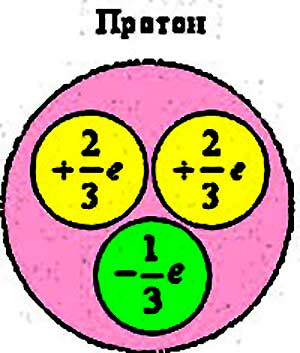
Many physicists have strengthened the view that quarks are fictitious, "mathematical" particles and that they can not exist in nature, and the theory of "color quarks" empowered quarks with properties similar to the colors of the spectrum. According to this theory, quarks are always combined just as you can, for example, combine red, blue and yellow colors to get white. Real particles, respectively, can only be "white", and we can not distinguish the "color" of individual quarks. In addition, theorists came up with "charmed" quarks.
However, the experimenters did not give up hope to find individual quarks sometime. This was done to William Fairbanks, George Peru and Arthur Hebbard. In this case, the charge of the quarks turned out to be less than the charge of the electron.
The technique of the experiment repeated Millikan's experience, but at a new technical level. The oil droplets that ran between the Milliken condenser plates were replaced by tiny niobium balls, the mass of which was naturally larger. In practice, this meant that the probability of detecting quarks was significantly higher. Indeed, according to modern estimates, one free quark among 1012 protons and neutrons can occur.
The ball hung in the field of a superconducting electromagnet. To reduce the effect of temperature, the working chamber was cooled to -2600 C. A pulsating voltage was applied to the plates of the capacitor, and if the ball had a charge, it began to oscillate in the electric field. The nature of the oscillations depended on the magnitude of the charge. For a year and a half, we managed to conduct a dozen experiments, and in three of them the charge of the ball turned out to be less than the charge of an electron, exactly one third.
In any case, Ferben was not discouraged. His installation worked twenty-four hours a day, and from time to time recorded fractional charges. Even the incomprehensible dependence of the appearance of quarks on the processing of niobium balls was established.
