Shan city
What is known about the beginning of Chinese history? It is known that in the 18th century BC to rule the country came the semi-legendary Yin dynasty. We have received lists of the rulers of this dynasty and some episodes from its history. But their reliability is more than doubtful, since the "historical" period in the history of China begins only from the 12th century BC, when the Zhou dynasty came to power. And what was before it? Was there really a Yin dynasty and its capital - Shan city?
Traditional Chinese medicine helped to open the monuments of the ancient civilization of China. Malaria, the main secretary of the Imperial Academy of Sciences, Wang Izhong, doctors prescribed "dragon bones". Wang Izhong saw on them the mysterious signs, resembling letters! These inscriptions were even older than the Chou!
It turned out that the "dragon bones" are nothing but ancient fortune-telling bones. The ancient Chinese appealed for help to the spirits and recognized their will, guessing with the help of bones and tortoise shells. These bones, often found in the places of ancient settlements and burial grounds. The inquiries of the pharmacists led the scientists to the Xiaotong village, located in Henan province, three kilometers from the county town of Anyang.
Chinese scientist Luo Zhengyu established that they mention the names of the kings of the Yin dynasty. It followed that the capital of the Yin Dynasty, the ancient city of Shan, should be in the vicinity of Anyana... The phantom dynasty began to acquire flesh and blood.
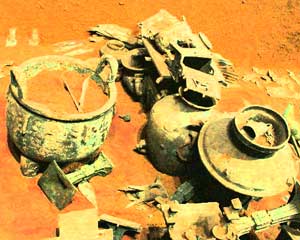
Since 1928, excavations began in Xiaotong. Before the archaeologists appeared the capital of the Yin dynasty - the great city of Shan. From under the ground the foundations of palaces and temples, the foundations of collapsed columns, the destroyed workshops of craftsmen, the dwellings of the nobility and common people rose. Archaeologists have uncovered many burials, including large royal tombs. They found hundreds of well-preserved human skeletons, the remains of chariots, the backbones of horses, numerous bronze vessels, magnificent marble sculptures, about the existence of which no one previously suspected.
Initially, the Yin called their dynasty "Shan". The name "Yin" appeared later. This state occupied the territory covering the present province of Henan. According to legend, the Yin people made their capital city Shan in the 14th century BC. After five times moved the capital from place to place. Around the city lay fertile land and fat pastures.
The city of Shan was surrounded by a wall and settled on an area of more than six square kilometers. Part of the city occupied the palace buildings. Quarters of craftsmen adjoined to them. Commoners and slaves huddled in dugouts with a height of about a man's height. The palaces of the ruler and the nobility looked quite different. They were built on high terraces of densely packed earth. Their basis was formed by three parallel rows of wooden columns, topped by a gable roof. The columns rested on stone or bronze grounds. The walls, apparently, were erected from the rammed earth and painted with colorful colors. Water flowed from the mountain lake along the wooden gutters to the noblemen's dwellings.
Not far from the palace complex was a temple with the so-called Yin oracle, where archaeologists found thousands of inscriptions on the bones of animals and tortoise shells, used for the ritual of fortune telling.
An outstanding role in the Yin religion was played by the worship of ancestors. It was believed that after death a person becomes a spirit that lives somewhere in the sky, and that the spirits of ancestors have great power over the affairs and lives of people. Even the tribes subordinated to the Yinans, and their enemies, were afraid of the mighty Chinese ancestors, whose strength was repeatedly proved by weapons.
To the spirits and gods the Yinans brought abundant sacrifices, mainly domestic and wild animals. From the products of agriculture, only beer was sacrificed. The Yinans sacrificed to the spirits and gods pieces of nephritis and cowrie shells, laying them on the altar. Human sacrifices were widely practiced. For this purpose, prisoners of war were used, to whom the heads were chopped off with bronze axes.
With the worship of their ancestors, the funeral traditions of the Yin people were associated. Their rulers and representatives of aristocratic families, they buried in luxurious tombs, reminiscent of an inverted truncated pyramid. These tombs were so large that some of them reached the size of a three-story house. Two or four sides were arranged entrances. Wide staircases with earth steps led to the sarcophagus, located at a depth of many meters. Its walls, built from logs and compacted earth, the Yin people covered with carvings and bright paintings, were painted with red, white and black paint. In the sarcophagus hall, a dead warrior or a dog was invariably buried, which were supposed to protect the deceased from evil spirits. In the center of the hall a coffin was placed with the body of the deceased.
The city of Shang was at the head of a fairly large political association. The ruler of the country was called "van". His power, apparently, was limited by the council of the nobility and the people's assembly. Van was the supreme commander and supreme priest. He led the farmers during agricultural work and chaired the hunt. Vana's power was hereditary. It was passed from the elder brother to the youngest and only for lack of such could pass to the son.
Shan city occupies an exceptional place in Chinese archeology. Thanks to the excavations conducted here, it was possible to answer the question about the origins of Chinese civilization. Previously, some scholars claimed that the bronze culture was brought to China by newcomers from the West. Now it is proved that this opinion was erroneous.
