Mariette and Egypt
Auguste Mariette and Egypt - are inextricably linked in the Egyptology of the 19th century. Even in his youth, carried away by the works of Champollion, Mariette seriously "fell ill" with Egypt.
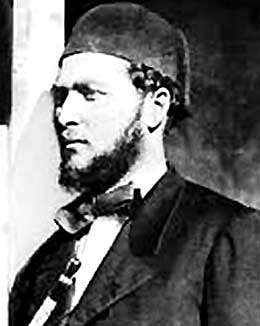
In 1850 Mariette went to Egypt in search of ancient Coptic manuscripts. In late October 1850, he began at his own risk and excavation in the Sakkar Necropolis. It rarely happens that a beginner archaeologist immediately achieved an outstanding result. But Marietta was lucky: by examining the Sakkar tombs to the northwest of the pyramids of Djoser, he stumbled upon the head of an almost completely sand-sphinx. Clearing the statue, Mariett read on the pedestal an inscription that glorified the sacred bull Apis, whom in Memphis was considered the incarnation of the god Ptah. This text made the scientist remember that the ancient geographer Strabo wrote in his time about a place near Memphis, where the ancient Temple of Serapeum was. The alley of the sphinxes led to the main entrance to this temple. Mariette had every reason to believe that he came across this alley.
Mariette hired several Fellahs and with their help for the year unearthed another 140 sphinxes or their remains. His hypothesis was fully confirmed: the sphinxes really formed the alley that led to the entrance to the Serapeum.
Ancient Egyptians, as you know, deified many animals, and in various parts of the country there were sacred animals: crocodiles, baboons, ibises. The sacred bull Apis, in the cult of which embodied the features of the ancient agricultural cult of a bull, was considered the embodiment of the god Ptah and patron of Memphis. Its main sanctuary was a temple located in Saqqara. He served as the seat of the sacred bull. When the bull was dead, it was embalmed and buried with all solemnity, and its place was occupied by another, with the same external signs as its predecessor. In the Greco-Roman period, the cult of the sacred bull merged with the cult of one of the main gods of the Greek Pantheon - Zeus, and also absorbed some purely Egyptian features of the myth of Osiris. Thus, a new deity named Serapis appeared. He was worshiped by both Greeks and Egyptians. The Greeks renamed the ancient temple of Apis in Serapeon, and then this name was transformed by the Romans into the Serapeum.
The Serapeum complex in Egypt consisted of two temples connected by a sphinx alley: the Ptah temple and an underground sanctuary where priests buried the mummies of sacred bulls. Mariette discovered him in November 1851. Access to the tombs of bulls was covered by a magnificent door made of sandstone. Behind it lay a huge underground room carved into the rock. It stretched from east to west for 200 meters and was a wide gallery with many side corridors and niches, where there were colossal granite sarcophagi, each weighing about 60-70 tons, in which once mummified sacred bulls. They were carved from polished black and red granite slabs and reached a height of more than three meters, a width of more than two and a length of up to four meters.
On each of the sarcophagi with hieroglyphs it was indicated who was the pharaoh and high priest in the life of one or another bull, what events occurred in this reign. The oldest sarcophagi belonged to the reign of Amenhotep the Third of the 18th dynasty, the latest - to the reign of the last Ptolemies. Thus, between the first and last burial there was a range of 1600 years! And the texts found by Marietta shed new light on the Egyptian history of this time.
Among this devastation, Marietta was fortunate enough to find the untouched burial of the sacred bull. He found in the petrified dust even the traces of workers who committed the burial. The whole was a bull mummy, richly decorated with gold and precious stones.
After the finds made in the Serapeum were exhibited in the Louvre, the name Marietta gained worldwide fame. Even a single Serapeum would be enough for it to remain forever in the history of Egyptology. But Mariette was not going to stop there.
In 1857, with the support of the Egyptian Khedive, Said-pasha, Mariette organized a museum in the Cairo suburb of Bulak. His incessantly expanding collections formed the basis of the famous Egyptian museum in Cairo.
Having started large-scale excavation, Mariette asked Said-pasha to allocate one of the premises of a transport company in Bulak for the storage of antiquities. Four rooms Mariette used for the most valuable exhibits, and others made stockpiles. At first he managed with the help of only one worker. Very soon a small collection of Marietta became so popular that in 1863 it was transferred to a new building that was officially opened on October 18 by Khedive Ismail.
Despite the great employment in the museum, Mariette continued to excavate himself. In 1865 he opened the tomb of the dignitary Ty, who was a large landowner and, as the texts say, "the head of all royal works, the head of the construction of the pyramids and the guardian of eternal places". This most beautiful and best preserved of the Sakkar tombs was built around 2600 BC - in those days, when the kings of Cheops, Chephren and Micherine built their pyramids. The walls of the tomb were covered with magnificent multi-colored reliefs, with their finest drawings that gave the impression of wall painting. These images are so realistic that they allowed us to determine what tools and tools used by the then farmers and artisans, what methods they used. None of the previously discovered graves provided such a real picture of the life of the ancient Egyptians, like this tomb.
Mariette also discovered many other tombs with similar evidence from ancient times, among which the tomb of Ptahhotep, the noblemen of the times of the 5th Dynasty, stood out. In addition, Mariett began studying the so-called false pyramid near Medum, the pyramid in Lisht and several small pyramids near Sakkar. Mariette unearthed the ruins of the funeral temple of the pharaoh Khafre, located near the Great Sphinx. From him to the pyramid of Khafre was the road of processions, along which the priests carried the mummified body of the pharaoh in the last path. From the temple there is little left, but the remaining parts of the entrance pylons and vestibule remains impress the eye with severity and proportionality of proportions. Among the ruins Mariette found a beautiful diorite statue of Khafre.
Mariette remained in Egypt for the rest of his life. He published numerous articles in European special journals, and also published several books. In 1867, Emperor Napoleon the Third awarded him the Order of the Legion of Honor, and in 1879 the Egyptian Khedive conferred the title of Pasha.
