Mikulchice
Pages of the early history of the Slavs were discovered only in the 20th century and exclusively due to archeology. Settled in the middle of the Danube region and the valleys of the Vltava, Laba (Elbe) and Moravian rivers, the Slavs entered the process of rapid social, economic and cultural development in the 5th-6th centuries. In the 30s of the 9th century the first Slavic state was formed - Great Moravia, which covered the territory of modern Moravia (part of the Czech Republic), northern Austria, western Slovakia and western Hungary (Pannonia).
In the 9th century from Byzantium to Moravia were sent Christian missionaries Cyril (Constantine) and Methodius, famous theologians and scholars from Solun (now Thessaloniki, Greece). The name of Cyril is associated with the creation of the Glagolitic Slavic alphabet. This became the most important event in the history of the Slavs, which initiated the development of their writing and culture.
The most interesting monument of the Great Moravian epoch is the fort site "On the Vales" near the village Mikulchice (southern Bohemia).
In the center of Mikulchice ancient settlement there was once a prince's castle occupying an area of 6 hectares. He was joined by fortified courtyards of nobles, behind them - a posad with log houses, drawn in the wrong rows. The whole settlement occupied an area of about 200 hectares. The presence of a large number of stone buildings - eleven churches and a large rectangular building, which can be considered a princely palace, speaks of the importance of the Mikulchice settlement in the Old Moravian state. Most likely, this is the former capital of Great Moravia, where in the year 863, after a long journey, the great Slavic enlighteners arrived, and the archbishop of which was the younger of the Salon brothers, Methodius.
The princely castle in Mikulchice was surrounded by a high shaft, lined with stone and consisting of internal chopped cages filled with rammed earth. The height of the shaft reached ten meters. The approaches to it were protected by several rows of stockade, a moat and a channel of the Morava River. To the prince's castle adjoined the fortifications of the land and the courtyards of the nobles, surrounded by stone walls and palisade. For that time it was an impregnable fortress, which caused the enemy to be shocked.
Of the eleven churches in Mikulchice, five were located on the castle grounds and six more in the posad and at the courts of the nobles. The construction technique of the Great Moravian architects testifies to the fact that they were experienced craftsmen trained in countries with a developed building tradition - most likely in the north-west of the Balkans, in Dalmatia. Direct analogies of monuments in Mikulchice can be found in ancient Croatian architecture.
In most cases, during the construction of stone buildings in the Great Moravian capital in Mikulchice, slabs of untreated sandstone were used, which was brought from the western slopes of the Carpathians. The stone was cemented with mortar, the walls were usually covered with polished plaster. Roofing ceramic material, such as Roman tiles, ancient Moravian builders burned themselves.
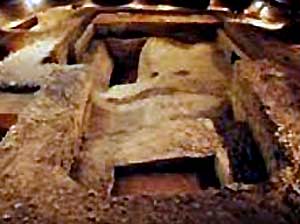
The most ancient and most interesting church of the Great Moravian capital in Mikulchice is the round rotunda church, which stood on a small hill near the prince's castle. It was built in the very beginning of the 9th century. From the temple, only one foundation survived, but the researchers were able to reconstruct its original appearance. Once the church was crowned with a dome and surrounded by a gallery on wooden poles, and inside the walls were covered with polished plaster and painted with frescoes, fragments of which still amaze with the fresh colors. Apparently, it was a princely house temple. But another temple, discovered on the territory of the castle in Mikulchice, was undoubtedly a cathedral, ie a bishop's cathedral and, therefore, is directly connected with the name of Methodius - the first Christian bishop of Great Moravia.
A rich burial was discovered at the altar part of the already mentioned princely church rotunda in Mikulchice. Among the finds made here are gilded spurs decorated with ornaments in the form of human masks and stylized figures, a gilded tip with the image of a human figure with its hands up. In the right hand the person holds something like a standard - a sign of the Roman imperial authority ("labarum"). In the left hand is a horn with oil, which the supreme priest performed anointing on the kingdom.
Workshops in Mikulchice and other cities of Great Moravia focused primarily on the production of expensive ornaments of gold and silver, which were very diverse. Monuments of great Moravian art discovered by archaeologists testify that much of what was created by the masters of this first Slavic state became a model for neighboring peoples.
