Mochica
The Moche Valley, located in the north of Peru, near the modern city of Trujillo, in the early and middle of the first millennium AD was the center of one of the most brilliant civilizations of America - Mochica. This culture was discovered in the late 19th century by the German archaeologist Max Ole. However, the greatest contribution to the study of the Moccan civilization was made by the Peruvian archaeologist Rafael Larko Oile.
And the Mochica civilization was indeed one of the most outstanding cultures of pre-Columbian America. Like the bearers of other Indian cultures of the Peruvian coast, Mochica Indians lived in valleys-oases, irrigated by rivers flowing into the sea. There are 24 such oases in the territory of Mochica, and one valley is separated from the other by a dead desert zone. However, regularly flooded valleys, like the valley of the Nile in Ancient Egypt, gave the Indians a wonderful harvest. Corn here ripened twice a year.
Mochica were skilled farmers. Cultivated land, they fertilized the guano and used the same tools, which after a thousand years used the Incas. They improved the quality of such already known crops as maize, beans, potatoes, yucca, peppers, tomatoes, etc.
Speaking about the processing of metals, it should be noted that Mochica did not know bronze. At the same time, they created delightful embossed ornaments from gold and alloys of gold, silver and copper.
Mochica was the first among the Indians of Peru to build wide stone-paved roads, although they were not familiar with the use of wheels. The remains of these roads can still be seen today in the valley of Chikama. The width of the roads in Mochik has always been exactly 9,8 m, and each side of some of their pyramids is 98 m, from which the researchers conclude that 9,8 m were in Mochica unit of length.
Their fields were irrigated by a branched system of canals. One of these channels, diverting water from the Chikama River, had a length of 113 km. Like the Romans, Mochika built huge and durable aqueducts. One of them, La Cumbre, has a length of 130 km. It serves to supply water to our days. Another aqueduct - Ascove, located in the valley of Chikama, reaches a height of 15 m, and in length – 1,4 km.
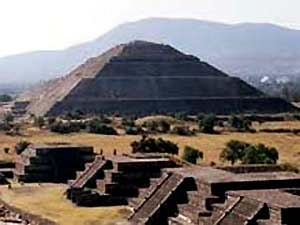
In addition, Mochica left a memory in the form of temples-pyramids. Two magnificent pyramids, erected not far from the modern Peruvian city of Trujillo, are especially famous. One of them was dedicated to the sun and is called today the Waca del Sol. The nearby Huaca de la Luna was dedicated to the moon. Both pyramids are sanctuaries located on several stepped platforms.
The pyramid of the Huaca del Sol is the largest Indian building on the Peruvian coast. Its length is 228 m and its width is about 140 m. The seven-sun temple built on its top has a height of 23 m, and the total height of the pyramid is 41 m.
In addition to these two pyramids, more than sixty pyramids and temple buildings have survived from the Mochica culture to the present day. On the walls of the pyramid in Panyamarke there have survived interesting wall paintings, which are called "pages of the history of Mochika". It shows almost the entire hierarchical structure of Mochik society.
Here is a priest or leader in a rich dress march accompanied by soldiers. Their figures are smaller, but the clothes of the warriors are as smart. The power of Mochik state is emphasized by constantly repeating military symbols - shits and batons for throwing. This power was fully experienced by the captives - strings of neck-tied ropes, naked and submissive people stretching along the walls. Some of the captives are going to sacrifice Ai-Apeku - the god of war; others are driven by Mochi warriors; others work on the extraction of guano-deposits of bird droppings on the coastal islands, used as fertilizer.
