Totonaki
Totonaki created one of the most developed cultures of pre-Columbian Mexico. This people lived on the coast of the Gulf of Mexico, on the territory of the present state of Veracruz. The first capital of the Totonaki was the city of El Tahin, whose ruins are located 8 km south-east of the Mexican city of Papantla. It was inhabited since the emergence of Totonaki culture (about 500 AD) and until the beginning of the 13th century.
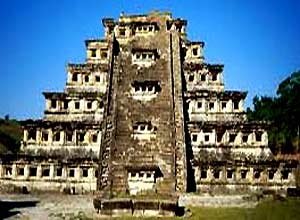
Materials of archaeological excavations, begun in 1934, testify that El-Takhin was the largest religious center of civilization, which the Totonaki created. Urban structures are located in a narrow valley and on the slopes of the mountains framing it, occupying an area of 959 hectares. They consist of two groups of buildings, built at different times.
The center of the valley occupies a temple-palace complex, the area of which is about 60 hectares. Most of the buildings were built in 600-900. The most interesting construction of the city is a seven-story, 18 m high, pyramid "El-Takhin" with hundreds of niches decorated with relief images of snakes. By the name of this pyramid, the city got its name. The square pyramid in the plan is oriented to the sides of the world. Its core consists of clay boulders clad, cladding made of ashlar. Vertical floors-ledges cut through 364 deep niches that distinguish this pyramid from similar structures of ancient America.
On the eastern side of the pyramid is built a staircase, numbering 364 steps - according to the number of days per year. The Totonaki, like all pre-Columbian Indian cultures, had their whole life strictly subordinated to the calendar. The last day - three hundred and sixty-fifth - marked a platform on top of the pyramid, on which, apparently, human sacrifices were made.
The Totonaki worshiped the main deity, the rain god. He and other gods (the goddess of heaven, the god of the sun, the god of corn, etc.) were hundreds of priests. Most of all the victims were brought to the god of rain.
In addition to the usual sacrifices, common among the Aztecs and the Mayans, the Totonaki regularly sacrificed children. During the great celebrations that took place every third year, the blood of the murdered children was mixed with fragrant tree juice and plant seeds, and the priests dressed it for all adult ritual participants.
With the religious rituals of the Totonaki, obviously, mysterious objects are associated, which are often found during the excavation of Totonaki towns. This is a stone yoke, similar to that worn on harnessed donkeys, but decorated with a rich relief. Typically, these items have the shape of a horseshoe up to half a meter and a width of up to 30 cm. Their appointment is associated with cruel Totonaki rituals - probably with the help of such a yoke the person being sacrificed was fixed in the "right position" or the yoke squeezed the neck of the victim, to move.
No less controversy is caused by the so-called stone "palm trees" - ceremonial axes, which the toonoks gave the shape of a palm leaf. They are made in the form of a triangular prism with a hole inside, but at the same time each ax is given the image of a stylized animal or person. Since these "palms" are most often found in the tombs of Totonaki nobles and especially the priests, it can be assumed that they were called upon to help the soul of the deceased to overcome obstacles on the way to the afterlife.
With the bloody rituals of the Totonaki, another object peculiar to this culture contrasts wonderfully: the image of a laughing human face. Nowhere else in America does such an image occur.
The Totonaki inhabited the lands on the coast of the Gulf of Mexico from the 7th century AD. until the arrival of the Spaniards. But since the 13th century, their culture has entered a period of decline, and Europeans have already found the agony of Totonaki civilization.
