Palenque
In the northern part of the Mexican state of Chiapas is located Palenque - the most famous city maya. It existed from the end of the 1st millennium BC to the end of the 1st millennium BC the heyday of the city Palenque fell on 7-8 centuries. At the end of the 1st millennium BC internal turmoil and the invasion of warlike tribes from the north led to the death of Palenque, and its ruins reliably concealed the impenetrable forest thicket.
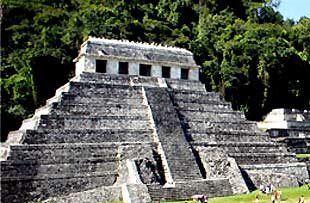
The legendary "Temple of Inscriptions" occupies a special place among the ancient monuments of Palenque. Struck by its greatness, it is part of the ensemble of the palace of Palenque rulers, and its white-stone pyramid is visible from the plain for many kilometers. "Temple of Inscriptions" got its name because of the abundance of hieroglyphic inscriptions on the walls, stairs, on sculptured columns.
Originally believed that the pyramidal temples in Maya cities - these are only pedestals for crowning their sanctuaries. But in the thick of such pyramids it was possible to find magnificent tombs of kings and members of ruling dynasties. The first such discovery was made in 1952 by the Mexican archaeologist Alberto Rus Luillier. When he explored the sanctuary of the "Temple of Inscriptions", he noticed that the floor in it was laid out of carefully pinned stone slabs. This was unusual for the Maya buildings. Opening the floor of the temple, the workers found a narrow passage, clogged with rubble, clearing which, a staircase appeared from the stone slabs. When the archaeologists cleared the ladder, they made their way to the corridor, partitioned by a thick wall of tightly stacked stone blocks, dismantled which, stumbled upon another stone wall in front of which stood a square stone box. In the box were magnificent jade decorations - beads and earrings, large shells filled with red paint, clay vases. Below lay two painted clay tablets and a large pearl with a diameter of one and a half centimeters. These items were undoubtedly ritual gifts. But to whom? The solution of the mystery was clearly behind the second wall.
This time, in the stone box found, lay the skeletons of five young men and girls of noble birth who were clearly sacrificed on some important and especially solemn occasion.
After examining the corridor, the workers found a triangular hole, beyond which a crypt opened, immersed in darkness, 9 m long and 4 m wide. On the walls of the crypt, the outlines of nine human figures, dressed in equal sumptuous suits, were visible: a headpiece from bird feathers quetzal, quaint mask, feather cap and jade plates, loincloth, belt with ornaments in the form of human heads, leather sandals from straps. In the center of the tomb stood a large stone sarcophagus covered with a rectangular plate with fine carvings, the edges of which were bordered by a ribbon of hieroglyphs. They corresponded to 603 and 633 years AD.
When archaeologists opened the sarcophagus, they saw at the bottom of a deep stone bowl, painted from the inside in red, the remains of the leader. This noble person, apparently, priest Palenque, did not have gold ornaments. But nearby there were a lot of items from nephritis - beads, rings , bracelets, earrings and gracefully carved statuettes. On each hand of the buried was a jade decoration. One piece of jade was in the mouth. The neck and shoulders were covered with a huge necklace of jade. On the skull remained the remains of a funerary mask, also made of the smallest pieces of jade.
