Saray-Batu
The Mongol-Tatar invasion led to the formation in the mid-1840s of the 13th century in the steppes of the Volga region of a new vast semi-state semi-nomadic - the Golden Horde.
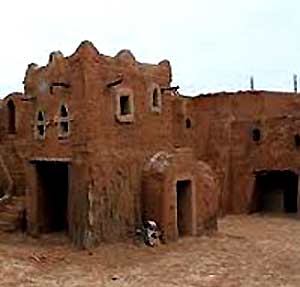
In a short historical period, huge cities grew on the Lower Volga - Saray-Batu, or Eski-Saray (Old Saray), and Saray-Berke - New Saray, created by the labor of a large number of captive builders and artisans. Both ancient sites are on the Akhtuba River, between Volgograd and Astrakhan.
The most impressive is the settlement of Saray-Batu, founded by Batu between 1242 and 1254, near the village of Selitrennoye. The settlement is amazing in its size. The eight huge gentle hills of Saray-Batu - Kamenny Bugor, Mayachny, Krasny - stretch along the left bank of Akhtuba for more than fifteen kilometers. In the second half of the 18th century, academician Pallas saw here the traces of buildings and the "brick of dug trenches", and on one of the hillocks of Saray-Batu - "the magnificent structure of the city and, as it seems, surrounded by a large castle...".
Since 1958, the exploration of the Golden Horde cities of Saray-Batu and Saray-Berke in the Lower Volga region is conducted by the Volga archaeological expedition, which for many years was headed by G.A. Fedorov-Davydov. The considerable archaeological material collected here allows today to draw conclusions about the social life, architecture and art of the Golden Horde cities.
According to the idea of the khans, Saray-Batu was to become a metropolitan city, in beauty and splendor not inferior to the most beautiful cities of the East. The city of Saray-Batu grew almost instantly in the steppes. At the beginning of the 14th century it was already a huge flowering capital - with thousands of houses, with numerous mosques (of which only the cathedral was thirteen), with palaces whose walls were sparkling with multicolored majolica tiles of intricate geometric or floral ornament. The famous Arab traveler Ibn Battuta, who visited Saray-Batu in 1333, was struck by his wealth, splendor and populousness. "The city of Saray-Batu", he wrote, "is one of the most beautiful cities, reaching an extraordinary size, on a level land crowded with people, beautiful bazaars and wide streets". Once we rode with one of the elders, intending to go around it and find out the dimensions We lived at one end of it and left it in the morning, and we reached the other end of it only after noon... and all this is a continuous row of houses where there are no empty places or gardens. There are thirty mosques for the cathedral service. In addition, there are still many other mosques. Saray-Batu is inhabited by different peoples, for example: the Mongols are real residents of the country and its lords, some of them are Muslims, aces who are Muslims, Kypchaks, Circassians and Russians and Byzantines, Christians. there are also their bazaars, merchants and strangers from both Iraqis, from Egypt, Syria and other places live in a special area where the walls surround the merchants' property".
Saray-Batu had a traditional face of the eastern city. Unless the streets in the center were somewhat wider than the narrow and narrow streets that are typical for the cities of the East. The bulk of the population lived in houses made of raw bricks or lined with wood. The poor were huddled on the outskirts of the dugouts. Mongol warriors, apparently, for a long time could not part with the nomadic way of life: in Saray-Batu, and in Novy Saray, the second capital of the Golden Horde, archaeologists found many yurt-like buildings. Although the city and destroyed the centuries-old life of the Mongols, but the traditions, it seems, got hooked into new conditions.
The house of a Mongol who settled in the town of Saray-Batu could not do without a traditional sufa - a spacious long couch stretching along three walls of the house. Inside the sufa, usually covered with carpets, a thermal pipeline passed through which the heat from the furnace (canal) passed.
Surprisingly rich and diverse pottery Saray-Batu. Here, the tradition of decorating the grand buildings - the khan's palace, the dignitaries' dwellings, mosques and mausoleums - with multicolored majolica tiles was extremely developed. Colorful watering tiles covered the cornices, framed door and window openings, formed frieze belts and whole panels. The patterns were traditionally oriental - the so-called wattle, vegetative ornament, stars and lilies with bizarre interlacing stems were used, the epic "kufi" ornament was a bizarre Arabic ligature. Specialists see the art traditions of Central Asia in the saraysky tile "laces" (Khorezm), Iran and Transcaucasia, but from this conglomerate something was born, inherent only in the Golden Horde art. F.V. Ballod, compared the mosaic of Saray-Batu with Samarkand and Persian.
It used to be that most of the pottery of Saray-Batu was imported. However, the excavations of the Volga expedition opened in Saray-Batu remnants of several ceramic workshops. The fact that in Saray-Batu were engaged in the production of ceramics, are found among the ruins of thousands of blanks, semi-finished products that have passed through various stages of the technological process, rejected vessels. Among them - luxurious bowls, covered with colorful watering with multicolored patterns, combining high technology with impeccable taste. The opening of the workshops made it possible to find out how the ceramics were made in Saray-Batu, dozens of forms were found for embossing relief patterns and modeling of the vessels themselves, and a shell was found in which the potter-artist rubbed and diluted the paint.
A lot of valuable information was given to excavations in the Saray-Batu aristocratic estates. Among other buildings, they stand out for their vast size. The obligatory elements of each such Saray-Batu manor was a grand central hall with a swimming pool, serving for solemn ceremonies and receptions. The walls of such halls were whitewashed and painted or decorated with tiles with painting and gilding. At some manors there were big bathing complexes - with chimneys heating a floor, with the big pools.
A similar picture was given to excavations of the extensive Tsarevsky hill fort in the Volgograd region, which hides the ruins of the second Golden Horde capital - the New Saray (Saray-Berke).
Short as a flash, the flowering of the cities of the Golden Horde Saray-Batu and Saray-Berke was replaced by long centuries of oblivion, until the ruins were touched by an archaeologist shovel.
