Great Zimbabwe
Between the two great African rivers of Zambezi and Limpopo for at least the last thousand years, the African Shona tribes live. It is believed that at this time the first kingdoms appeared in the southeast of Africa, in the development of which a huge role was played by the extraction of gold. Almost all the medieval centers of the Black Continent, including great Zimbabwe - the huge and mysterious city of the Shona people have grown on gold. Originated in the 11th century, and the heyday is at the end of the 14th - beginning of the 15th century, its ruins are located about three hundred kilometers south of Harare, the current capital of the Republic of Zimbabwe. When in 1871 Karl Mauch discovered the Great Zimbabwe, Europe was amazed: how could backward Africans living in thatched huts build such a magnificent stone city?
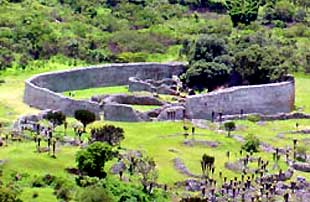
First of all, Great Zimbabwe is surprised by the fact that there are no streets, and there are simply paths between private dwellings; there are no areas for general meetings, there are no monumental buildings or markets, no commercial or industrial zones. Urban buildings were built haphazardly, in accordance with the needs for housing, and not for some general plan. There were no city walls here - the home of each family was protected by its own wall. All structures are constructed by the method of cyclopean masonry, without a fastening mortar and reproduce the shapes of wooden fences that can be seen in any African village.
Great Zimbabwe includes several complexes. A separate huge building - an elliptical building dominates the valley. It is surrounded by several concentric fences, behind which in an area of 4600 square meters a conical stone tower with a height of more than 9 m, and remains of at least forty more stone buildings. The outer wall of the Elliptical building reaches a length of 244 m, a thickness of 5,2 m and a height of 9,8 m. It was estimated that about 120 thousand tons of granite blocks were used for the construction of all the structures of this complex. Probably, the elliptical building was the palace of the ruler of Great Zimbabwe - the Mven of Mugapa.
On the next top is the "Acropolis", or "Ruins on the Hill". It covers an area of about 2600 square meters. The power and extent of its colossal, dilapidated stone walls, towering in solitude in the middle of a deserted savannah, make a huge impression.
Great Zimbabwe was a major center of crafts. Here we worked with gold, copper and iron. In the "Ruins on the Hill" and the Elliptical building, archaeologists found a lot of gold beads, gold wire and thin gold plates, which covered the carved wooden products. Thousands of once-developed mines were also discovered: gold and copper mines, iron ore deposits, tin mines. Huge areas of terraces on which the most diverse plants were grown, canals for irrigation, stone ruins of settlements and cemeteries, wells reaching a depth of twelve meters, knocked out right in the rocks, are all dumb witnesses of a highly developed and long-ago culture.
But when trade contacts with the coast were interrupted in the mid-15th century, Great Zimbabwe began to decline. The final fall of Great Zimbabwe was promoted by the fact that the historical trade routes that had passed into the hands of the Portuguese came to desolation. However, about half a century before the arrival of the Portuguese, the rulers of Zimbabwe moved their political center to the north, to the central part of the Zambezi valley. Shortly thereafter, between members of the ruling family began a struggle for power, for owning land and benefits in trade. The empire broke up into rival possessions. The oral traditions of the Shona people claim that in the middle of the 15th century the ruler of Great Zimbabwe left his "house in the south" and moved to the Zambezi valley, "due to lack of salt". But no explanation has yet found documentary evidence, so the Great Zimbabwe continues to keep its secret.
